
Warren Buffett’s Berkshire Hathaway owns one of the world’s most closely watched investment portfolios. It holds approximately 45 stocks and exchange-traded funds (ETFs) representing a broad range of industries. Its top three holdings are Apple, American Express, and Bank of America.
Many investors look to Berkshire Hathaway’s portfolio for ideas because those stocks and ETFs are approved by the Oracle of Omaha himself. Berkshire’s own stock has also consistently outperformed the S&P 500 index over the past six decades.
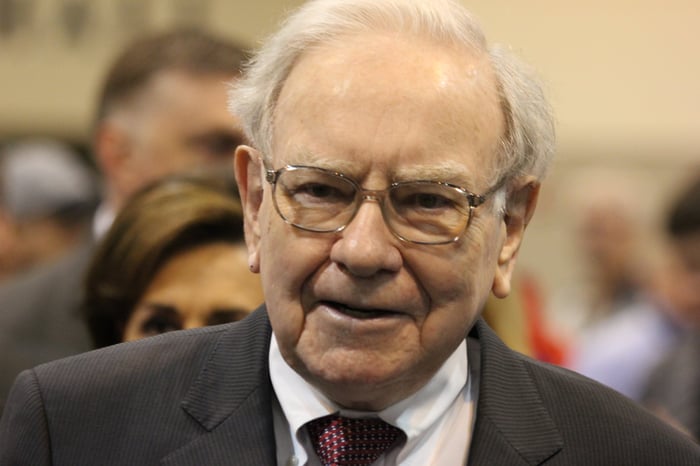
Berkshire Hathaway CEO Warren Buffett. Image source: The Motley Fool.
I’ve dug deeper into some of Berkshire’s newer holdings like Chubb and Ulta Beauty, but his older position in Amazon (NASDAQ: AMZN) also deserves some attention. Berkshire started to invest in Amazon in 2019, and the company’s $1.87 billion stake now accounts for 0.6% of its portfolio. Let’s see why Amazon’s stock could soar even higher over the next few years.
Understanding Amazon’s core growth engines
Amazon generates most of its revenue from its online marketplaces, but it reaps most of its profits from Amazon Web Services (AWS), the world’s largest cloud infrastructure platform. AWS operates its business at much higher margins than its retail businesses, so it usually subsidizes the growth of its lower-margin e-commerce business with its cloud-based profits. It’s also been expanding its smaller and higher-margin advertising business for the same reason.
That’s why Amazon can afford to consistently expand its retail business with discounts, free shipping options, cheap hardware devices, and other perks for its Prime members. It’s already locked in more than 200 million Prime members worldwide, and that sticky ecosystem gives it a wide moat against other online and brick-and-mortar retailers.
Amazon isn’t a typical Buffett stock
Warren Buffett generally prefers companies that can maintain a gross margin of over 40% and a net profit margin of at least 20%. However, Amazon doesn’t usually report its gross margin. In its latest 10-K filing for 2023, it says its operating margin is a “more meaningful measure” that better reflects the diversity of its product categories and services than its gross margin. On the bottom line, it only posted a net profit margin of 5.2% for the full year.
That said, many of Berkshire’s other current holdings also don’t make the cut with their current gross and net profit margins. But many of those companies still impressed Warren Buffett with their wide moats and clear competitive advantages.
Amazon has a massive moat because it’s both the top e-commerce and cloud infrastructure company in the world. Its North American retail segment generated $353 billion in net sales in 2023. By comparison, its closest competitor, Walmart, generated just over $100 billion in e-commerce sales in fiscal 2024 (which ended this January).
AWS controlled 33% of the cloud infrastructure market in the second quarter of 2024, according to Canalys. Microsoft‘s Azure ranked second with a 20% share, followed by Alphabet‘s Google Cloud with a 10% share. AWS’ lead ranking puts it in a comfortable position to profit from the secular growth of the AI market, which is driving more companies to upgrade their cloud computing and storage capabilities to handle the latest AI applications.
What happened to Amazon over the past two years?
In 2022, Amazon’s net sales only increased 9% as macro headwinds throttled its growth. Inflationary headwinds broadly curbed consumer spending, and rising interest rates drove many companies to rein in their cloud spending. Amazon also posted a net loss for the year as its investment in the struggling EV maker Rivian withered.
But in 2023, Amazon’s revenue grew 12% as the macro environment stabilized. It also returned to profitability, since the AI market generated fresh tailwinds for AWS. To profit from the future growth of that hot market, it’s been developing its own accelerator chips, investing in new large language models, and rolling out new tools that make it easier for clients to develop custom chatbots and generative AI tools. That expansion should widen its moat against Microsoft, which has already integrated OpenAI’s generative AI tools into Azure, Bing, and its cloud-based productivity services.
Why could Amazon go parabolic in 2025 and beyond?
From 2023 to 2026, analysts expect Amazon’s revenue to grow at a compound annual growth rate (CAGR) of 11% as its EPS rises at a CAGR of 36%. Amazon’s stock still looks reasonably valued, relatively speaking, at 32 times next year’s earnings.
If Amazon matches analysts’ expectations and still trades at the same forward multiple, its stock price could rise 25% to about $234 by the end of 2025. If it trades at a more generous 50 times forward earnings by then, its stock could nearly double to about $365. Therefore, Amazon’s stock could still have plenty of room to run over the next few years — and it could attract a lot more growth-oriented investors as interest rates cool off again.
Should you invest $1,000 in Amazon right now?
Before you buy stock in Amazon, consider this:
The Motley Fool Stock Advisor analyst team just identified what they believe are the 10 best stocks for investors to buy now… and Amazon wasn’t one of them. The 10 stocks that made the cut could produce monster returns in the coming years.
Consider when Nvidia made this list on April 15, 2005… if you invested $1,000 at the time of our recommendation, you’d have $814,364!*
Stock Advisor provides investors with an easy-to-follow blueprint for success, including guidance on building a portfolio, regular updates from analysts, and two new stock picks each month. The Stock Advisor service has more than quadrupled the return of S&P 500 since 2002*.
*Stock Advisor returns as of October 7, 2024
Bank of America is an advertising partner of The Ascent, a Motley Fool company. John Mackey, former CEO of Whole Foods Market, an Amazon subsidiary, is a member of The Motley Fool’s board of directors. Suzanne Frey, an executive at Alphabet, is a member of The Motley Fool’s board of directors. American Express is an advertising partner of The Ascent, a Motley Fool company. Leo Sun has positions in Amazon, Apple, and Berkshire Hathaway. The Motley Fool has positions in and recommends Alphabet, Amazon, Apple, Bank of America, Berkshire Hathaway, Microsoft, Ulta Beauty, and Walmart. The Motley Fool recommends the following options: long January 2026 $395 calls on Microsoft and short January 2026 $405 calls on Microsoft. The Motley Fool has a disclosure policy.
5 Stocks Our Experts Predict Could Double In the Next Year
By submitting your email, you'll also get a free pivot & flow membership. A free daily market overview. You can unsubscribe at any time.