Key Points
Warren Buffett acquired a controlling stake in a struggling textiles manufacturer called Berkshire Hathaway (NYSE: BRKA)(NYSE: BRKB) in 1965, and after realizing its core business wasn’t viable, he converted it into a holding company for his various investments. By the time he stepped away from his role as chief executive in 2025, Berkshire was worth over $1 trillion, with numerous wholly owned subsidiaries, a $350 billion stock portfolio, and almost $400 billion in cash.
The stock returned 19.7% annually during Buffett’s 60-year tenure, meaning an investment of just $500 in 1965 would have grown to $24 million by the end of 2025. The conglomerate’s new CEO, Greg Abel, worked with Buffett for two decades before taking over, so he’s likely to maintain a similar strategy to his predecessor. That means focusing on companies with steady growth, reliable earnings, and experienced management.
Missed Nvidia in 2009? This Rare Signal Is Flashing Again. In 2009, a “Double Down” signal flashed for a little-known chipmaker called Nvidia. For the first time in years, that same “Total Conviction” signal is flashing for a company 1/100th the size of Nvidia. Continue »
Abel hit the ground running and has already quadrupled Berkshire’s stake in one technology company operating at the forefront of the artificial intelligence (AI) revolution. A different AI giant is also Berkshire’s largest holding, and together, these two stocks account for almost 30% of the conglomerate’s entire portfolio. Read on.
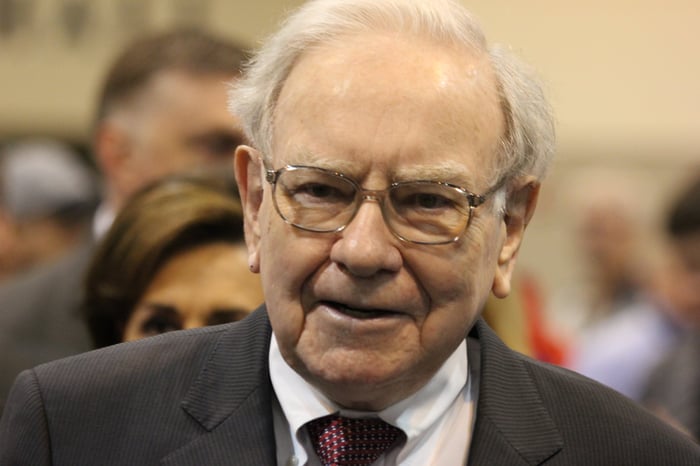
Image source: The Motley Fool.
Alphabet: 10.2% of Berkshire’s portfolio
Alphabet (NASDAQ: GOOG)(NASDAQ: GOOGL) is the tech giant behind Google Search, Google Cloud, YouTube, Waymo, and more. The advertising dollars generated by Google Search account for more than half of the company’s total revenue, so there were some initial concerns when applications like OpenAI’s ChatGPT came along, because they presented consumers with a more convenient way to find information online.
But Alphabet has developed a series of new AI features to defend Google Search’s market position. They include AI Overviews, which are AI-generated responses that appear at the top of the traditional search results, and AI Mode, which takes users to a chatbot-style interface where they can expand on their original query with further questions.
AI Mode already has more than 1 billion monthly active users, and Alphabet says these new features have combined to increase Google Search use overall. That means users are seeing more ads, and so Alphabet is making more money. The platform generated a record $63.3 billion in revenue during the second quarter of 2026 (ended June 30), up 17% from the year-ago period.
And then there is Google Cloud, a platform where businesses can access computing capacity from state-of-the-art data centers, and ready-made large language models (LLMs) from some of the industry’s top developers. These are the primary ingredients required to create AI software, and demand is through the roof — as of June 30, Google Cloud had a $514 billion order backlog from customers who were waiting for more AI data centers to come online. The platform’s total revenue exploded higher by 82% to $24.8 billion during the second quarter.
Berkshire first bought Alphabet stock in the third quarter of 2025, while Buffett was still at the helm. But Abel has quadrupled the conglomerate’s position since the start of 2026, which now stands at 78.8 million Class A shares and 27.2 million Class C shares, worth a combined $36.6 billion.
The stock has soared by 70% over the past year, but there could be more upside ahead if the company’s search and cloud businesses continue to grow at the current pace.
2. Apple: 19.5% of Berkshire’s portfolio
Apple (NASDAQ: AAPL) is the company behind the iPhone, iPad, and Mac computers. Unlike Alphabet, it isn’t spending hundreds of billions of dollars to build enormous data centers all over the world. Instead, it’s focusing on integrating AI features into its devices via its new Apple Intelligence software to enhance the user experience.
Apple Intelligence includes writing tools, which enable users to summarize and generate text messages or emails with the touch of a button. It also learns which incoming notifications are most important to each user, so it can prioritize them to save time. The feature also includes a revamped version of the Siri voice assistant, which is powered by Alphabet’s Gemini family of large language models.
Apple designs the processing chips for all of its flagship devices in-house, which means it can tailor their hardware specifically for Apple Intelligence. This is advantageous when it comes to providing the best processing speed and battery life, but it also helps secure the company’s supply chain, which is especially crucial now since most chipmakers are struggling to keep up with AI-related demand.
Considering Apple has over 2.5 billion active devices worldwide, it could soon become one of the biggest distributors of AI software to consumers. That is mighty impressive since it’s probably investing the least money in AI infrastructure relative to all of its trillion-dollar peers in the tech sector.
Buffett invested roughly $38 billion in Apple stock between 2016 and 2023. Heading into 2024, that position had grown to over $170 billion, accounting for half the value of Berkshire’s entire portfolio. Buffett and his team sold 75% of the conglomerate’s stake by the end of 2025 to cash in some of those gains and to reduce risk.
Nevertheless, the company remains Berkshire’s largest position with a portfolio weighting of 19.5%, so the conglomerate will still do very well over the long term if Apple’s AI strategy pays off.
Should you buy stock in Alphabet right now?
Before you buy stock in Alphabet, consider this:
The Motley Fool Stock Advisor analyst team just identified what they believe are the 10 best stocks for investors to buy now… and Alphabet wasn’t one of them. The 10 stocks that made the cut could produce monster returns in the coming years.
Consider when Netflix made this list on December 17, 2004… if you invested $1,000 at the time of our recommendation, you’d have $419,408!* Or when Nvidia made this list on April 15, 2005… if you invested $1,000 at the time of our recommendation, you’d have $1,348,694!*
Now, it’s worth noting Stock Advisor’s total average return is 966% — a market-crushing outperformance compared to 213% for the S&P 500. Don’t miss the latest top 10 list, available with Stock Advisor, and join an investing community built by individual investors for individual investors.
*Stock Advisor returns as of August 20, 2026.
Anthony Di Pizio has no position in any of the stocks mentioned. The Motley Fool has positions in and recommends Alphabet, Apple, and Berkshire Hathaway. The Motley Fool has a disclosure policy.
5 Stocks Our Experts Predict Could Double In the Next Year
By submitting your email, you'll also get a free pivot & flow membership. A free daily market overview. You can unsubscribe at any time.