
Get the latest insights on Bitcoin, Ether and altcoins, along with a round-up of key cryptocurrencymarket news
Here’s a quick recap of the crypto landscape for Friday (July 10) as of 10:00 p.m. UTC.
Bitcoin price update
Bitcoin (BTC) was priced at US$63,884.43 , up by 0.9 percent over the past 24 hours.
Simon-Peter Massabni, head of business development at XS.com, is cautiously optimistic despite significant external pressures. Geopolitical tensions and macroeconomic uncertainty have triggered market volatility and concerns over inflation, and insufficient liquidity in the market threatens the sustainability of Bitcoin’s recent upward trend.
“BTC is still struggling to attract sufficient liquidity across multiple channels to fuel further recovery,” he said in an emailed statement. “Network activity remains glum. According to CoinGlass data, the 100-day moving average of new addresses on the blockchain has hit a fresh low of 281K, the lowest since August 2024.”
“Whales also do not seem inclined to hoard BTC even at current low prices, and the blockchain lost 10 whales holding 1K-10k BTC over the past month,” according to BGeometrics. “Furthermore, BTC spot exchange-traded funds (ETFs) are unable to attract consistent and sufficient inflows over the long term.”
According to SoSo Value, after 10 days of continued outflows from these ETFs, they were unable to attract inflows for more than 3 days, with only around US$500 million recorded following US$2.71 billion of outflows over those 10 days.
Overall, direction depends heavily on the conflict in the Middle East and upcoming US economic policy decisions.
Bitcoin price chart
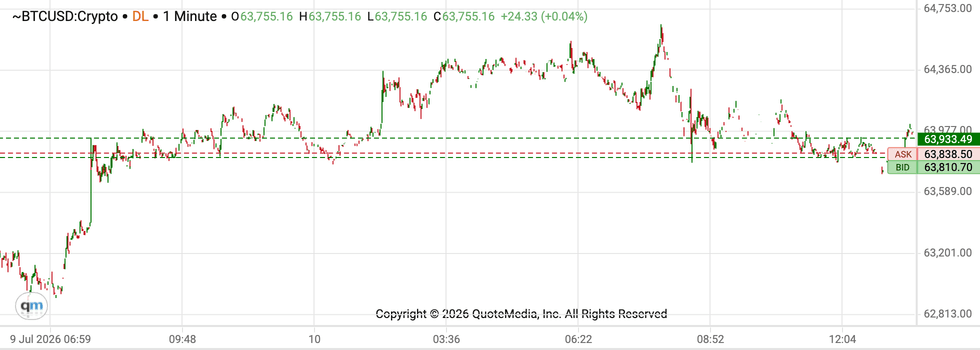
Chart via the Investing News Network.
Bitcoin price performance, July 10, 2026.
Ether and altcoin price update
- Ether (ETH) was priced at US$1,791.73, trading 1.9 percent higher over the last 24 hours.
- XRP (XRP) was priced at US$1.11, trading 0.4 percent higher over the past 24 hours.
- Solana (SOL) was trading at US$77.92, trading 0.9 percent lower over the past 24 hours.
Today’s crypto news to know
Read on for a round-up of the biggest cryptomarket news
- Aave rolls out Stable Vaults
- PayPal’s PYUSD on Polygon
- Hyperliquid and Phantom vs. CFTC rules
- Circle to launch first national digital currency trust bank
- Polymarket files for US broker license
- North Carolina recognizes CFTC authority over prediction markets
Aave rolls out Stable Vaults
Aave Labs has launched Stable Vaults, a new stablecoin yield product designed to let businesses embed stablecoin earning features without requiring users to manage DeFi positions directly.
Depositors accrue yield per second through assigned SubVaults, while an operator allocates capital across approved Aave markets, Savings GHO and other ERC-4626 strategies. The structure shifts rate setting, liquidity management, bridging and allocation into a controlled product layer.
PayPal’s PYUSD on Polygon
PayPal (NASDAQ:PYPL) is moving its stablecoin, PYUSD, onto Polygon, a blockchain known for cheaper and faster transactions. This will enable PYUSD to be used more like a normal digital dollar in more apps and wallets.
Hyperliquid and Phantom vs. CFTC rules
Hyperliquid and Phantom have asked US regulators to treat DeFi software and non-custodial wallets differently from traditional brokers. Specifically, the companies want the Commodity Futures Trading Commission (CFTC) to establish rules ensuring building code alone does not trigger heavy financial registration rules.
Additionally, they want the law to allow modern DeFi infrastructure to plug into regulated markets, and for Phantom’s earlier no-action relief to become a broader, permanent policy.
Their basic argument is that if a wallet or app is just a tool that helps users reach a market, but does not hold customer funds or act like a broker, it should not be forced into old broker rules built for Wall Street intermediaries.
If regulators agree, it could make it easier for crypto apps to offer trading features without having to become heavily regulated financial brokers. If they do not agree, some DeFi and wallet products could face more compliance burden, which could slow down product launches in the US.
Circle to launch first national digital currency trust bank
Circle Internet Group (NYSE:CRCL) achieved a major regulatory breakthrough on Friday after the US Office of the Comptroller of the Currency authorized the creation of its own national trust bank.
The highly anticipated approval led to a 13 percent premarket surge for Circle’s stock as investors cheered the company’s reduced reliance on external commercial banking partners. The newly chartered entity will operate under the name Circle National Trust and function under direct federal banking oversight.
Historically, the massive cash and short-term US treasury reserves backing Circle’s flagship USDC stablecoin have been managed by third-party financial institutions. With this trust bank charter, Circle can eventually transition to holding those multibillion-dollar reserve assets under its own federally regulated custody.
Under the new regulations, traditional players such as banks and institutional investors will now find it substantially easier to utilize Circle’s digital asset custody and blockchain-based payment infrastructure.
Polymarket files for US broker license
Polymarket is pushing to expand its regulated presence in the US by seeking federal approval to introduce leveraged margin trading, according to a report by Bloomberg.
The prediction market operator officially submitted an application for a Futures Commission Merchant (FCM) license on July 3 through its corporate affiliate, Coming Home GBA. If granted, the license would allow eligible users to trade event contracts without fully collateralizing every position. Kalshi, one of the firm’s direct competitors, secured its own FCM license earlier this year to build a regulated domestic brokerage framework.
However, before Polymarket can legally roll out margined contracts, the company must also convince the Commodity Futures Trading Commission to approve necessary amendments to its internal rulebook.
North Carolina recognizes CFTC authority over prediction markets
North Carolina has officially bucked a widening state-level crackdown on prediction markets by formally acknowledging the exclusive jurisdiction of federal commodities regulators.
Governor Josh Stein signed Senate Bill 257 on Tuesday (July 7), folding the regulatory protections into the state’s 2026 budget. The new statute explicitly declares that any prediction market registered and licensed by the Commodity Futures Trading Commission can operate legally within North Carolina borders.
State lawmakers are leaving the heavy regulatory oversight to Washington, opting instead to simply levy a flat 6 percent tax on operators’ net trading fee revenue derived from state residents starting in 2027.
This hands-off approach contrasts sharply with the state’s aggressive stance toward traditional sports bookmakers, who just saw their gross wagering revenue tax hiked from 18 percent to 23 percent.
Don’t forget to follow us @INN_Technology for real-time news updates!
Securities Disclosure: I, Meagen Seatter, hold no direct investment interest in any company mentioned in this article.
Securities Disclosure: I, Giann Liguid, hold no direct investment interest in any company mentioned in this article.
Editorial Disclosure: The Investing News Network does not guarantee the accuracy or thoroughness of the information reported in the interviews it conducts. The opinions expressed in these interviews do not reflect the opinions of the Investing News Network and do not constitute investment advice. All readers are encouraged to perform their own due diligence.
5 Stocks Our Experts Predict Could Double In the Next Year
By submitting your email, you'll also get a free pivot & flow membership. A free daily market overview. You can unsubscribe at any time.