
Key Points
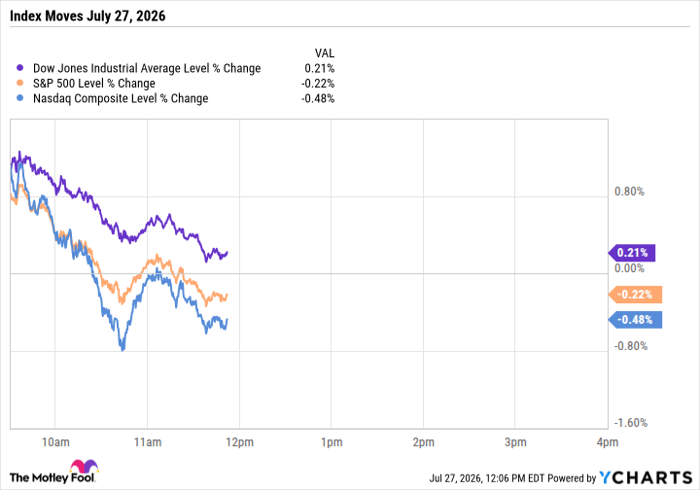
The Dow held a 0.2% gain at midday while the S&P 500 and Nasdaq turned negative.
Chinese semiconductor news triggered a broad chip selloff, dragging Nvidia, AMD, and Micron lower.
Four Magnificent Seven earnings reports this week will test investor confidence in AI spending.
- 10 stocks we like better than NASDAQ Composite Index ›
Wall Street woke up in a good mood on Monday. Oil prices were tumbling on news of a U.S.-Iran ceasefire, and all three major indexes opened solidly higher. By midday, that optimism had largely evaporated.
The Dow Jones Industrial Average (DJINDICES: ^DJI) was clinging to a 0.2% gain at 12:06 p.m. ET, down from an early peak of 1.3%. The S&P 500 (SNPINDEX: ^GSPC) had slipped 0.2% into the red after starting the day up 0.9%. The Nasdaq Composite (NASDAQINDEX: ^IXIC) was off 0.5%, having completely erased its 1.1% opening pop.
Where to invest $1,000 right now? Our analyst team just revealed what they believe are the 10 best stocks to buy right now, when you join Stock Advisor. See the stocks »
Oil plunges, chips sink
Brent crude dropped approximately 6% to around $86.40 per barrel after the U.S. and Iran agreed to pause military strikes while diplomatic talks resume. Lower oil means less inflation pressure, which means the Fed might ease up on rate hikes. Treasury yields dipped accordingly.
On the downside, China’s semiconductor industry picked today to flex.
ChangXin Memory Technologies (CXMT) went public in Shanghai and promptly became China’s most valuable listed company, with a valuation near $490 billion. Meanwhile, a Shanghai firm has started mass-producing DUV lithography machines. That’s the kind of equipment ASML Holding (NASDAQ: ASML) has had a near-monopoly on for years, and ASML shares dropped more than 7% on the news.

Image source: Getty Images.
The resulting semiconductor sell-off was broad and ugly. Nvidia fell 4.3%, AMD SK Hynix sank 8.5%, and Micron Technology lost roughly 5%. The companies didn’t exactly do anything wrong. Market makers just decided to take down their lofty valuations a bit in light of the Chinese chip news.
The mega-cap software and services stocks counterbalanced the semiconductor drops. Microsoft (NASDAQ: MSFT) rose 2.3%, Alphabet (NASDAQ: GOOGL) added 2.8%, and Apple gained 1.3%. On the Dow, Caterpillar (NYSE: CAT) was the biggest drag, down 4.6% and 243 Dow points.
The week gets interesting from here
Stop me if you’ve heard this before, but the week ahead could get bumpy.
The Fed announces its next rate decision on Wednesday, and there’s a real chance of a hike. Then come a bunch of Magnificent 7 earnings: Microsoft and Meta Platforms report on Wednesday, followed by Apple and Amazon on Thursday.
Those reports will provide concrete data on AI infrastructure spending at a time when investors are questioning whether the returns justify the costs. The semiconductor stocks getting hammered today are the same ones that need big tech to keep writing big checks. After Alphabet’s disappointing report last week, the stakes are high.
For long-term investors, weeks like this are useful precisely because they’re uncomfortable. Volatility shakes out weak hands and creates better entry points. The real question is whether you’re ready to act when everyone else is panicking.
Should you buy stock in NASDAQ Composite Index right now?
Before you buy stock in NASDAQ Composite Index, consider this:
The Motley Fool Stock Advisor analyst team just identified what they believe are the 10 best stocks for investors to buy now… and NASDAQ Composite Index wasn’t one of them. The 10 stocks that made the cut could produce monster returns in the coming years.
Consider when Netflix made this list on December 17, 2004… if you invested $1,000 at the time of our recommendation, you’d have $377,990!* Or when Nvidia made this list on April 15, 2005… if you invested $1,000 at the time of our recommendation, you’d have $1,269,518!*
Now, it’s worth noting Stock Advisor’s total average return is 896% — a market-crushing outperformance compared to 206% for the S&P 500. Don’t miss the latest top 10 list, available with Stock Advisor, and join an investing community built by individual investors for individual investors.
*Stock Advisor returns as of July 27, 2026.
Anders Bylund has positions in Alphabet, Amazon, Micron Technology, and Nvidia. The Motley Fool has positions in and recommends ASML, Advanced Micro Devices, Alphabet, Amazon, Apple, Caterpillar, Meta Platforms, Micron Technology, Microsoft, and Nvidia. The Motley Fool has a disclosure policy.
5 Stocks Our Experts Predict Could Double In the Next Year
By submitting your email, you'll also get a free pivot & flow membership. A free daily market overview. You can unsubscribe at any time.