
Key Points
Alibaba’s stock has plunged nearly 70% from its all-time high.
Macro, competitive, and regulatory challenges are compressing its valuation.
Investors shouldn’t underestimate the impact of the Trump Administration’s tariffs.
- 10 stocks we like better than Alibaba Group ›
Alibaba (NYSE: BABA), China’s largest e-commerce and cloud infrastructure company, set a record high of $307.84 on Oct. 27, 2020. That marked a 353% gain from its IPO price of $68 on Sept. 18, 2014. At the time, its core businesses were firing on all cylinders, and it was considered one of the safest ways to profit from China’s economic growth.
But today, Alibaba’s stock trades at about $95. Its stock collapsed amid fierce regulatory, competitive, and macroeconomic headwinds. China’s antitrust crackdown on Alibaba’s e-commerce business in 2021 eroded its defenses against competitors, and the post-pandemic slowdown caused many companies to rein in cloud spending. Inflation and higher oil prices also drove up its labor and logistics expenses, and it struggled to offset those rising costs.
Missed Nvidia in 2009? This Rare Signal Is Flashing Again. In 2009, a “Double Down” signal flashed for a little-known chipmaker called Nvidia. For the first time in years, that same “Total Conviction” signal is flashing for a company 1/100th the size of Nvidia. Continue »
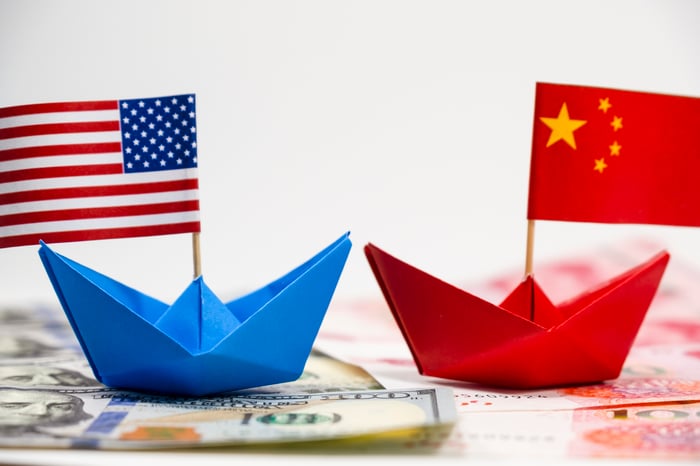
Image source: Getty Images.
However, investors often overlook the impact of the Trump Administration’s tariffs on Alibaba’s long-term growth. At first glance, Alibaba seems insulated from those tariffs because it generates most of its revenue in China and doesn’t rely heavily on cross-border trade. But if we dig deeper, we’ll see that Alibaba isn’t completely immune to those policy shifts.
How will Trump’s trade policies impact Alibaba?
Alibaba generates about three-quarters of its e-commerce revenue from its Taobao and Tmall marketplaces in China. The rest comes from its overseas marketplaces (including Lazada in Southeast Asia, Trendyol in Turkey, and Daraz in South Asia) and its AliExpress cross-border marketplace, which connects its Chinese merchants to overseas buyers.
Only about a fifth of AliExpress’ gross merchandise volume (GMV) comes from the United States. That’s the only part of Alibaba’s massive e-commerce business exposed to Trump’s tariffs on Chinese goods and the suspension of the “de minimis” exemption that allowed duty-free entry for packages valued at under $800. Many cross-border marketplaces, like Shein and PDD‘s Temu, relied heavily on that loophole to ship cheap products from China to the U.S., but AliExpress is much less dependent on the U.S. market.
A more pressing risk is the Trump Administration’s addition of Alibaba to the Department of Defense’s list of “Chinese Military Companies”. That designation bars Alibaba from acquiring high-end data center chips from Nvidia and prevents U.S. companies and government agencies from using its cloud infrastructure services. That pressure will prevent Alibaba from expanding its cloud business into the U.S. and many other Western countries, and force it to ramp up spending to develop its own domestic chips.
Lastly, Trump’s tariffs on Chinese goods will create macroeconomic headwinds for China’s economy. That pressure could hurt some of Alibaba’s domestic merchants, which use its wholesale platform, Alibaba.com, to export products to U.S. businesses. It could also throttle consumer spending on its e-commerce platforms and enterprise spending on its cloud services.
Alibaba has other irons in the fire
Alibaba faces many near-term challenges, but it has plenty of irons in the fire. Its overseas marketplaces are growing much faster than its domestic ones, its cloud business is thriving as companies ramp up their spending on AI infrastructure services, and its Cainiao logistics business is still expanding and evolving into its third growth engine.
From fiscal 2026 (which ended this March) to fiscal 2029, analysts expect Alibaba’s revenue and EPS to grow at CAGRs of 11% and 20%, respectively. Its stock still looks like a bargain at 17 times this year’s earnings, since near-term concerns about macro and competitive challenges are weighing on its valuation, but those headwinds should eventually dissipate.
If you believe China’s e-commerce and cloud markets will continue to grow regardless of the Trump Administration’s unpredictable tariffs and trade policies, then it’s still a great time to buy Alibaba’s stock. It probably won’t skyrocket this year, but it could outperform many other Chinese stocks as it’s revalued as a reliable growth play again.
Should you buy stock in Alibaba Group right now?
Before you buy stock in Alibaba Group, consider this:
The Motley Fool Stock Advisor analyst team just identified what they believe are the 10 best stocks for investors to buy now… and Alibaba Group wasn’t one of them. The 10 stocks that made the cut could produce monster returns in the coming years.
Consider when Netflix made this list on December 17, 2004… if you invested $1,000 at the time of our recommendation, you’d have $382,359!* Or when Nvidia made this list on April 15, 2005… if you invested $1,000 at the time of our recommendation, you’d have $1,201,390!*
Now, it’s worth noting Stock Advisor’s total average return is 883% — a market-crushing outperformance compared to 205% for the S&P 500. Don’t miss the latest top 10 list, available with Stock Advisor, and join an investing community built by individual investors for individual investors.
*Stock Advisor returns as of June 26, 2026.
Leo Sun has no position in any of the stocks mentioned. The Motley Fool has positions in and recommends Nvidia. The Motley Fool recommends Alibaba Group. The Motley Fool has a disclosure policy.
5 Stocks Our Experts Predict Could Double In the Next Year
By submitting your email, you'll also get a free pivot & flow membership. A free daily market overview. You can unsubscribe at any time.