
Key Points
Tesla designed an autonomous robotaxi called the Cybercab, but commercializing it comes with a number of challenges.
Uber operates the world’s largest ride-hailing platform, and around 30 companies in the autonomous space are deploying their vehicles in its network.
Uber’s strategy could be far more lucrative than Tesla’s strategy over the long term.
- 10 stocks we like better than Uber Technologies ›
Tesla (NASDAQ: TSLA) recently started manufacturing its Cybercab autonomous robotaxi, but it faces two problems. First, the company’s full self-driving software lacks widespread regulatory approval in the U.S., so the robotaxi won’t be hitting the road at scale anytime soon. Second, Tesla is behind other operators, like Alphabet‘s Waymo, which is already completing over 500,000 paid autonomous trips per week.
Simply put, the autonomous arms race is complex, competitive, and extremely capital-intensive, but there is one company bypassing those challenges, and it could be the industry’s ultimate winner. Uber Technologies operates the world’s largest ride-hailing platform, and it has partnered with around 30 companies in the autonomous industry that are deploying their vehicles in its network.
Missed Nvidia in 2009? This Rare Signal Is Flashing Again. In 2009, a “Double Down” signal flashed for a little-known chipmaker called Nvidia. For the first time in years, that same “Total Conviction” signal is flashing for a company 1/100th the size of Nvidia. Continue »
Here’s why Uber’s strategy could deliver much better results for investors than Tesla’s strategy.
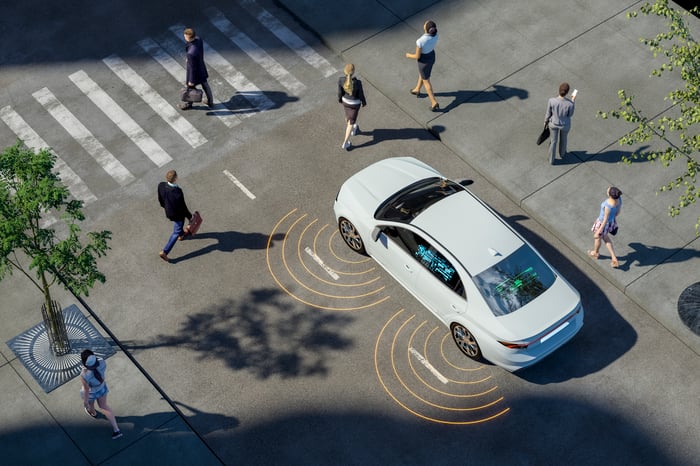
Image source: Getty Images.
Autonomous vehicles will transform Uber’s business
For most manufacturers of autonomous vehicles, designing a great car is the easy part. The real challenge is building a network, attracting customers, and providing rides in a timely fashion. Uber has mastered all of those things, which is why dozens of companies in the autonomous space — including Waymo — are deploying their cars into its network rather than building their own, and it’s a win for all parties.
Uber’s autonomous partners get instant access to its 199 million monthly active users, and Uber gets to offer its customers a wide selection of autonomous rides without incurring the exorbitant cost of manufacturing its own cars. The ride-hailing giant will simply take a cut of every ride facilitated by its platform, the same way it does with human-driven rides.
Financially speaking, the shift to autonomous vehicles will be transformative for Uber. The company reported $53.7 billion in gross bookings during the first quarter of 2026, which was the dollar value of every ride, food order, and commercial delivery paid for through its platform. Historical data suggests around 44%, or $23.6 billion, of those bookings were likely paid to the human drivers who operate in its network. They are consistently Uber’s single highest cost.
After excluding other costs, like the money paid to restaurants for their food orders, Uber was left with $13.2 billion in revenue for the first quarter. After accounting for operating expenses like marketing, the company’s operating income was just $1.9 billion. That’s right, Uber pocketed less than 4% of its $53.7 billion in gross bookings as operating profit.
Theoretically, if Uber eliminated the cost of its human drivers by using autonomous vehicles instead, it would have earned $23.6 billion in additional revenue during the first quarter alone. Some of that money would have been paid to the owners of the self-driving vehicles in its network, but I think that cost will be far lower than the cost of human drivers in the long run, particularly because autonomous cars can operate around the clock without sleep, lunch breaks, or vacations.
As of March 31, self-driving cars were available in eight U.S. cities through Uber, with plans to expand to 15 cities by the end of 2026. Moreover, CEO Dara Khosrowshahi said autonomous trips soared tenfold year over year during the first quarter, so they are scaling up fast.
Uber stock is more attractively valued than Tesla stock
Khosrowshahi thinks the autonomous revolution will be a multitrillion-dollar opportunity over the long term, so where investors choose to put their money could be the difference between disappointment and life-changing returns. Uber stock is entering this new era at a very attractive valuation, but the same can’t be said for Tesla stock.
Uber’s price-to-sales (P/S) ratio is just 2.7 as I write this, which is a discount to its long-term average of 4.1 dating back to when the company went public in 2019. It also means Uber is much cheaper than the Nasdaq-100 technology index, which has a P/S ratio of 6.3.

UBER PS Ratio data by YCharts
Tesla’s P/S ratio of 13.6 is 5 times higher than Uber’s, and double that of the Nasdaq-100. Many investors are backing Tesla because of the potential of its Cybercab robotaxi and its Optimus humanoid robot. But in my opinion, its valuation doesn’t accurately reflect the risks associated with commercializing these products, which means its stock could suffer a sharp correction if they run into any speed bumps.
As a result, I think Uber stock is a much better buy than Tesla stock as the autonomous revolution ramps up.
Should you buy stock in Uber Technologies right now?
Before you buy stock in Uber Technologies, consider this:
The Motley Fool Stock Advisor analyst team just identified what they believe are the 10 best stocks for investors to buy now… and Uber Technologies wasn’t one of them. The 10 stocks that made the cut could produce monster returns in the coming years.
Consider when Netflix made this list on December 17, 2004… if you invested $1,000 at the time of our recommendation, you’d have $369,577!* Or when Nvidia made this list on April 15, 2005… if you invested $1,000 at the time of our recommendation, you’d have $1,301,557!*
Now, it’s worth noting Stock Advisor’s total average return is 908% — a market-crushing outperformance compared to 208% for the S&P 500. Don’t miss the latest top 10 list, available with Stock Advisor, and join an investing community built by individual investors for individual investors.
*Stock Advisor returns as of July 23, 2026.
Anthony Di Pizio has no position in any of the stocks mentioned. The Motley Fool has positions in and recommends Alphabet, Tesla, and Uber Technologies. The Motley Fool has a disclosure policy.
5 Stocks Our Experts Predict Could Double In the Next Year
By submitting your email, you'll also get a free pivot & flow membership. A free daily market overview. You can unsubscribe at any time.