
Easily one of the top market performers over the past one-year period, big data analytics specialist Palantir Technologies Inc PLTR commands serious respect, gaining almost 235%. However, some kinks are starting to appear in the company’s vaunted armor. For example, in the trailing month, PLTR stock shed 29%, an uncharacteristic bout of volatility.
Up until the second half of February, Palantir seemingly could do no wrong. Fundamentally, advocates of PLTR stock could point to the transformative power of artificial intelligence. According to a recent McKinsey report, generative AI could increase productivity (depending on the use case) by between $2.6 trillion and $4.4 trillion annually. With Palantir pushing the envelope of advanced analytics, investors believed the company could justify its rich valuation.
One of the most prominent voices urging a rethink was Cathie Wood. Her Ark Invest fund had been consistently selling PLTR stock while the masses were buying. Last month, the situation came to a head when Palanatir’s top insiders – those who knew the business the best – decided to offload a significant volume of shares.
To be fair, corporate executives can sell their holdings for a number of reasons, including non-salacious ones such as tax considerations. Nevertheless, the timing wasn’t exactly favorable. Against economic indicators signaling the rising possibility of a recession, growth-oriented names became incredibly suspect.
At the same time, it wouldn’t be accurate to characterize PLTR stock as hopelessly doomed. A few days ago, Palantir CEO Alex Karp met with South Korea’s shipbuilding conglomerate Hyundai Heavy Industries Group to advance the concept of AI-driven shipyard innovation. In addition, the two teams discussed future defense capabilities.
Per a statement by Hyundai, the two companies agreed that AI-based defense solutions could play a meaningful role in national security for both South Korea and the U.S. Indeed, Precedence Research noted that the global AI in aerospace and defense market could reach a valuation of $65.43 billion by 2034, implying a compound annual growth rate (CAGR) of 9.91% from 2024.
Moreover, Palantir itself has urged the Pentagon to embrace a software-first approach, lest it risk the U.S. lagging behind global adversaries. Part of the argument is financial. The big data specialist believes that software represents “the most compelling way” to close security gaps between the U.S. and its main rivals.
The Direxion ETFs: Given the twists and turns of the Palantir narrative, investors may find utility in Direxion’s PLTR-focused exchange-traded funds. For the optimist, the Direxion Daily PLTR Bull 2X Shares PLTU delivers 200%-leveraged exposure to the analytics firm. On the other end of the scale, the Direxion Daily PLTR Bear 1X Shares PLTD offers 100% of the inverse performance of PLTR stock.
Both Direxion funds offer enhanced solutions – either leverage or bearish transactions – without resorting to options trading. While trading derivatives can be a rewarding experience, they require additional education to master. With leveraged or inverse ETFs, these products can be acquired much like shares of a publicly traded company.
Of course, no investment opportunity is without risk. For Direxion’s PLTU and PLTD ETFs, these vehicles are designed for single-day exposure only. Holding leveraged or inverse funds for longer than recommended may lead to a performance disconnect with the underlying asset due to the daily compounding of volatility.
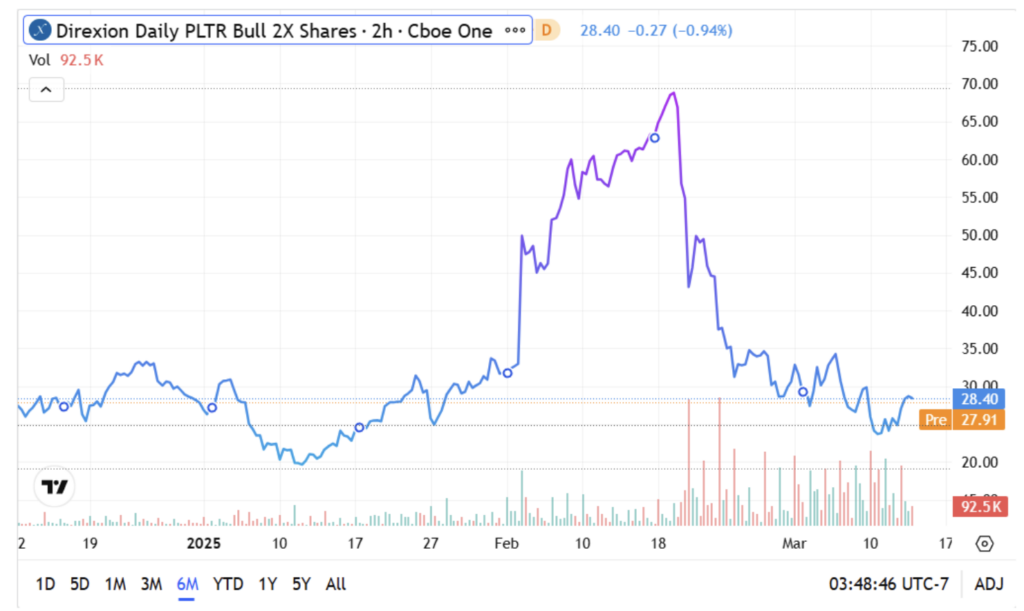
The PLTU ETF: Having launched in December last year, the Direxion PLTR bull fund got off to a rocking start before succumbing to selling pressure.
- After falling for several sessions, some positive momentum is starting to creep into the PLTU ETF, accompanied by a large boost in volume.
- However, the pronounced peak in late December, followed by a dramatic spike in February, lends credence to the idea that PLTU could be forming a bearish head-and-shoulders pattern.
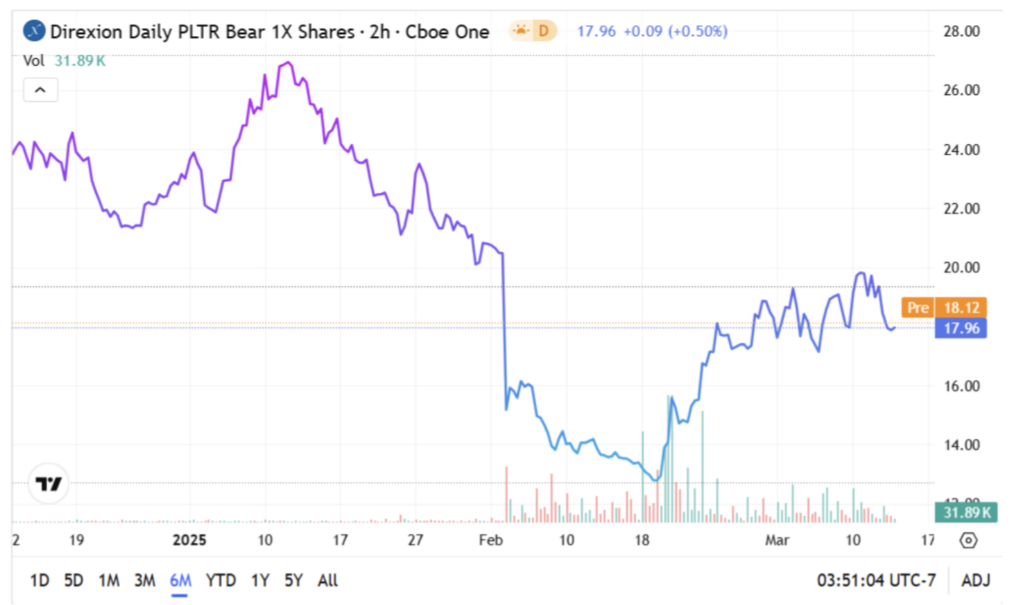
The PLTD ETF: Also making its debut in December 2024, the Direxion PLTR bear fund is down almost 26% despite not being in the market for that long.
- What might get lost in the narrative is the near-term momentum. In the past month, PLTD has gained nearly 33% of market value.
- Currently, PLTD is sandwiched between its 20-day exponential moving average at bottom and the 50-day moving average at top. However, another negative market event could result in a big spike higher.
Featured image by Jensen Art Co from Pixabay.
Momentum–
Growth–
Quality–
Value–
Market News and Data brought to you by Benzinga APIs
5 Stocks Our Experts Predict Could Double In the Next Year
By submitting your email, you'll also get a free pivot & flow membership. A free daily market overview. You can unsubscribe at any time.