
This could yield the most promising AI investment opportunities for the next five years
We’ve been pounding the table on the AI Megatrend for years now … chips, cloud, software, robotics … all of it.
But the chart I’m about to show you might be the single most important AI chart of the decade:
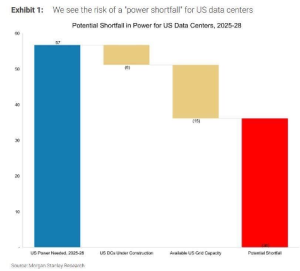
It comes from Morgan Stanley Research and shows a looming “power shortfall” — the yawning gap between how much electricity America’s data centers will need and how much the U.S. grid can realistically supply.
In plain English: the AI Boom is about to slam into a wall of physics.
Morgan Stanley estimates that between 2025 and 2028, U.S. data centers will need an additional 57 gigawatts of power. That’s like adding the electricity consumption of dozens of major cities … in just three years.
But right now, there are only 6 GW currently under construction…
The grid can cough up maybe 15 GW in spare capacity … that leaves a 36 GW shortfall … a gaping red hole on the chart.
We’re calling it “The Crunch” — the moment when AI ambitions outstrip the energy supply needed to fuel them.
And it could spark the most promising AI investment opportunities of the next five years.
Why This Crunch Is a Big Deal
Everyone’s been obsessing over GPUs, semiconductors, and whether Nvidia can keep shipping trillions of transistors. But this chart tells us that the real bottleneck isn’t chips … it’s gigawatts.
No electricity, no AI. Period.
If the U.S. doesn’t add 36 GW of new supply by 2028, some trillion-dollar data center projects won’t even be able to flip the “on” switch.
This changes the investment conversation entirely. The winners of the AI Boom aren’t just the usual suspects — Nvidia (NVDA), Microsoft (MSFT), and Alphabet (GOOGL).
The new winners will be the companies that solve The Crunch.
How to Plug the Crunch by 2028
1. Natural Gas: The Fast Patch (~12 GW)
Natural gas plants are quick to build (2–4 years) and provide reliable baseload power. They’ll almost certainly fill part of the shortfall. Think Vistra (VST) and Constellation (CEG).
But gas comes with baggage — emissions, politics, and permitting. It won’t cover the entire gap.
2. Renewables + Storage (~8 GW effective)
Solar and wind will keep scaling. Hyperscalers are already signing massive green power purchase agreements (PPAs). But here’s the rub: 20 GW of solar might only deliver about 5 GW of firm power. Storage helps, but it’s expensive.
Still, this could add up to around 8 GW toward closing The Crunch. Plays include First Solar (FSLR), Enphase (ENPH), and AES Corp (AES).
3. SMRs & Microreactors (~12–15 GW)
Here’s the moonshot (and the biggest opportunity) …
Small modular reactors (SMRs) and microreactors can be factory-built, shipped on trucks, and plugged in almost anywhere. They range from 5 to 300 MW per unit and can be sited right next to data centers — bypassing grid bottlenecks.
And they’re fast. Instead of a 10–15 year megaproject, an SMR can be deployed in just 2–5 years.
That’s why we’re bullish on SMRs and microreactors filling the largest slice of The Crunch — 12 to 15 GW by 2028.
Key names to watch:
- Oklo (OKLO): Backed by Sam Altman, targeting first deployments mid-decade. A favorite of ours.
- BWXT (BWXT): Builds reactors for NASA and the DoD; already working on military microreactors. Another top pick.
- Nuscale (SMR): Facing delays but still has a shot, with strong government backing.
- X-energy: DOE-backed, targeting deployments later this decade.
Don’t overlook the strategic tailwind: the U.S. Army is already commissioning Project Janus to deploy microreactors on military bases. Once proven, commercial hyperscalers like Microsoft and Google will be next.
4. Efficiency & Optimization (~2–4 GW avoided)
Alongside boosting supply, hyperscalers will invest heavily in making data centers more efficient — trimming overall energy demand.
Cooling, server utilization, and chip efficiency improvements could reduce power needs by a few gigawatts. It’s not huge, but it matters. Think Vertiv (VRT) and Eaton (ETN) as potential plays.
Add it all up, and here’s how the Crunch could get plugged:
- Natural Gas: ~12 GW
- Renewables + Storage: ~8 GW
- SMRs & Microreactors: ~12–15 GW
- Efficiency Gains: ~2–4 GW
= ≈36 GW
Notice what’s doing the heavy lifting here: SMRs and microreactors.
Why SMRs Are the Dark Horse
Big nuclear reactors? Excellent long-term solution, but far too slow. They take more than a decade to build.
SMRs and microreactors, on the other hand, are tailor-made for this moment:
- Fast to Deploy: 2–5 years instead of 10+.
- Flexible Siting: Install next to data centers without massive grid buildouts.
- 24/7 Power: Unlike wind and solar, they don’t depend on weather.
- Government Backing: DoD, DOE, and now the Army’s Project Janus.
SMRs aren’t a “someday” technology anymore. The Crunch makes them an immediate necessity.
The Crunch Trade: Who Wins
Nuclear Core
- Oklo (OKLO): The purest small-reactor play.
- BWXT (BWXT): Microreactor leader with DoD/NASA contracts.
- Nuscale (SMR), X-energy: Wildcards that could rebound if adoption accelerates.
- Cameco (CCJ): Uranium supplier — no fuel, no reactors.
Grid & Transmission
- Quanta (PWR), Eaton (ETN), Schneider Electric (SBGSY): Expanding and modernizing the grid to deliver all that new power.
Utilities & IPPs
- Constellation (CEG), Vistra (VST): Utilities that own the plants and sell the power.
Data Center REITs
- Equinix (EQIX), Digital Realty (DLR): More power = more capacity = more revenue.
Final Word
This is the oil shock of the 21st century.
In the 20th century, oil was the bottleneck commodity. In the 2020s, it’s electricity. AI has turned power into the new oil.
A 36 GW shortfall by 2028 is equivalent to building 30–35 nuclear reactors … or powering the entire state of California. That’s the scale of The Crunch.
So yes, the AI Boom is real. But it’s about to hit a wall of physics. Data centers don’t run on code … they run on kilowatts.
And that’s why The Crunch is the most important (and overlooked) investment theme of the AI decade.
If you want to be positioned not just for the AI software and chips, but for the energy revolution that powers them, SMRs and microreactors are your ticket.
Wall Street still sees them as “someday tech.” But when GPU farms start tripping breakers and hyperscalers realize they can’t keep up, SMRs won’t be optional … they’ll be essential.
The Crunch will decide how far AI can go, and who gets rich from it.
The next wave of AI is happening in robotics: where AI is leaping off the screen and into the real world.
Factories, warehouses, and even hospitals are deploying intelligent machines powered by the same algorithms driving Big Tech’s profits.
It’s the natural extension of the AI super-cycle – and it’s where we see the next 10x opportunity emerging.
Discover the top plays to stake an early claim in the AI-robotics boom.
5 Stocks Our Experts Predict Could Double In the Next Year
By submitting your email, you'll also get a free pivot & flow membership. A free daily market overview. You can unsubscribe at any time.