Key Points
The S&P 500’s top 10 holdings now make up around 40% of the index’s total value.
At that level of concentration, a handful of companies can have a meaningful impact on the overall market.
History suggests that long-term investors will be rewarded the most, no matter what’s ahead.
- 10 stocks we like better than S&P 500 Index ›
For much of the past few years, major market indexes have experienced unprecedented growth. The S&P 500 (SNPINDEX: ^GSPC) is up nearly 77% over the past three years alone, as of this writing, while the tech-heavy Nasdaq Composite (NASDAQINDEX: ^IXIC) has soared by around 94% over the same period.
Much of this growth can be attributed to large tech stocks. The AI boom has driven up valuations, and massive companies now account for a historically large share of the market — even more so than during the dot-com bubble of the early 2000s.
Missed Nvidia in 2009? This Rare Signal Is Flashing Again. In 2009, a “Double Down” signal flashed for a little-known chipmaker called Nvidia. For the first time in years, that same “Total Conviction” signal is flashing for a company 1/100th the size of Nvidia. Continue »
In many ways, the market is in uncharted territory. Many analysts argue that large stocks are still fairly priced despite record-breaking valuations, making it debatable whether this is a true bubble. That said, some investors are understandably nervous about investing when the S&P 500 is dominated by a handful of tech companies.
Fortunately, history still has some positive news for investors willing to maintain a long-term outlook.

Image source: Getty Images.
The S&P 500 is becoming incredibly concentrated
In 2000, the S&P 500’s top 10 largest holdings accounted for around 23% of the index’s overall value, according to data from FactSet Research. In 2026, the top 10 stocks make up more than 40% of the S&P 500.
The “Magnificent Seven” — which includes Apple, Alphabet, Amazon, Meta Platforms, Microsoft, Nvidia, and Tesla — collectively make up around one-third of the S&P 500’s value. All of these stocks have a market cap of at least $1 trillion, and AI is a common thread among them.
Because the index is so concentrated, a relatively small number of stocks can significantly influence the S&P 500’s performance.
Since late May 2026, the S&P 500 is down by nearly 3%. However, excluding the Magnificent Seven, the rest of the S&P 500 is actually up by around 2.5% over that period. Tech stocks have been pummeled in recent weeks, largely over concerns around AI spending, and they’ve been dragging the rest of the market down with them.
What history says about what’s coming
To be clear, history can’t predict the market’s future, and each downturn is different. If history can tell us anything, though, it’s that the market is incredibly resilient over the long term.
If AI takes a turn for the worse and the tech industry plunges, it could significantly affect the S&P 500. But this isn’t the first time the S&P 500 has been tested, and it’s still managed to survive every downturn so far.
During the bear market following the dot-com bubble burst, for example, the S&P 500 fell by more than 47%. A few years later, during the Great Recession, the index lost more than 55% of its value. However, since 2000, the S&P 500 has earned total returns of more than 700%.
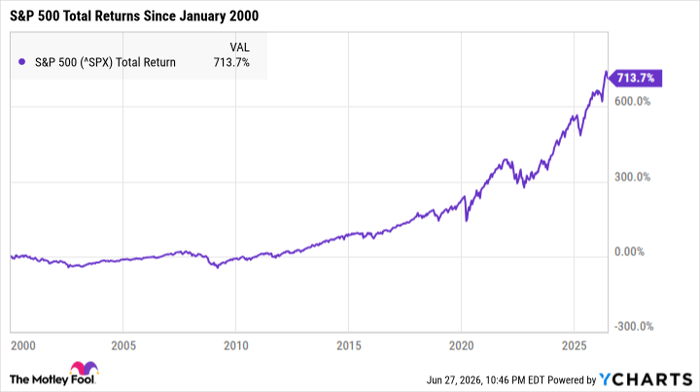
No matter what’s coming for the market, a long-term outlook is key. Worst-case scenario, if the S&P 500 loses the majority of its value during the next downturn, history has proved that the market can recover with enough time.
One move all investors should make right now
The future may be uncertain, but the best way to prepare for potential turbulence is to invest only in healthy stocks with solid fundamentals — which includes everything from robust finances to a competitive advantage over peers to an experienced leadership team.
Healthy companies are still vulnerable to short-term volatility, and sometimes those downturns can be severe. But organizations built on strong foundations are well-positioned to weather periods of economic instability and deliver positive long-term returns.
Patience is the most important trait investors can have right now. If history proves anything, it’s that the stock market rewards those who stay invested for the long haul.
Should you buy stock in S&P 500 Index right now?
Before you buy stock in S&P 500 Index, consider this:
The Motley Fool Stock Advisor analyst team just identified what they believe are the 10 best stocks for investors to buy now… and S&P 500 Index wasn’t one of them. The 10 stocks that made the cut could produce monster returns in the coming years.
Consider when Netflix made this list on December 17, 2004… if you invested $1,000 at the time of our recommendation, you’d have $398,052!* Or when Nvidia made this list on April 15, 2005… if you invested $1,000 at the time of our recommendation, you’d have $1,181,688!*
Now, it’s worth noting Stock Advisor’s total average return is 892% — a market-crushing outperformance compared to 205% for the S&P 500. Don’t miss the latest top 10 list, available with Stock Advisor, and join an investing community built by individual investors for individual investors.
*Stock Advisor returns as of June 30, 2026.
Katie Brockman has no position in any of the stocks mentioned. The Motley Fool has positions in and recommends Alphabet, Amazon, Apple, FactSet Research Systems, Meta Platforms, Microsoft, Nvidia, and Tesla. The Motley Fool has a disclosure policy.
5 Stocks Our Experts Predict Could Double In the Next Year
By submitting your email, you'll also get a free pivot & flow membership. A free daily market overview. You can unsubscribe at any time.