Key Points
Retiring with $1 million in the bank is a dream for many Americans, and it’s becoming an increasing reality for those who invest consistently in the stock market.
There’s a simple formula for maximizing your odds: start early, diversify, and add funds consistently. While creating your own portfolio of around 50 carefully curated stocks is your best chance at success, it can be surprisingly easy to get there by choosing a growth-oriented exchange-traded fund (ETF) in addition, or even on its own.
Missed Nvidia in 2009? This Rare Signal Is Flashing Again. In 2009, a “Double Down” signal flashed for a little-known chipmaker called Nvidia. For the first time in years, that same “Total Conviction” signal is flashing for a company 1/100th the size of Nvidia. Continue »
One fantastic option is the Vanguard Russell 1000 Growth ETF (NASDAQ: VONG). It has an excellent long-term track record and could make you a millionaire if you invest $100 a month for 30 years. Here’s how it works.
The top U.S. growth stocks
The Russell 1000 is an index of 1,000 large-cap U.S. stocks, and the Russell 1000 Growth Index includes about 400 of the largest ones. The VONG ETF tracks the index, simplifying growth investing by providing access to top stocks.
Since it’s a weighted index, the largest-cap stocks account for more of the total, and the ETF is similarly composed. Nvidia, for example, represents 13.8% of the total weight, followed by Apple (6.7%), Alphabet (6.1% class A shares and 5% class B shares), Broadcom (5.2%), and Microsoft (4.1%). Most of the components account for a tiny percentage, many less than 0.1%.

Image source: Getty Images.
Since the index focuses on large-cap stocks, it naturally tends toward growth, since the highest-growing stocks eventually become bigger. There are plenty of large value stocks, too, so you get companies like Colgate-Palmolive and Heico mixed together with companies like Sandisk and CoreWeave. Value stocks reduce some risk, but there’s no getting around this ETF’s concentration in higher-risk stocks.
Today, it’s concentrated in artificial intelligence (AI) and AI-adjacent stocks, since that’s what’s moving the markets. However, because the components are included based on specific rules, this can easily change along with trends.
Since it’s a Vanguard ETF that has a passive management strategy, it has a low expense ratio of 0.06%.
Market-beating performance
The VONG ETF was started in 2010, and since then, it’s been one of Vanguard’s best-performing ETFs. Over the past 15 years, it has delivered an annualized gain of 16%, versus 14.2% for the S&P 500. Over 15 years, that translates into a lot more money.
Since the index trades out low-performing stocks in favor of high-performing ones, the model tends to deliver healthy performance over time. If you start with a $10,000 investment and assume a 15% annualized rate over the next 30 years, and you add $100 every month through every kind of market, you’ll have nearly $1.2 million in the end.
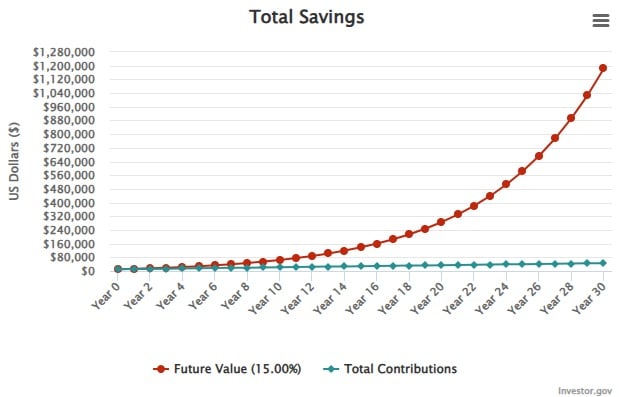
Image source: Investor.gov.
There’s no guarantee it will maintain this rate, but starting now, adding funds consistently, and letting your investment compound can build wealth over time.
Should you buy stock in Vanguard Scottsdale Funds – Vanguard Russell 1000 Growth ETF right now?
Before you buy stock in Vanguard Scottsdale Funds – Vanguard Russell 1000 Growth ETF, consider this:
The Motley Fool Stock Advisor analyst team just identified what they believe are the 10 best stocks for investors to buy now… and Vanguard Scottsdale Funds – Vanguard Russell 1000 Growth ETF wasn’t one of them. The 10 stocks that made the cut could produce monster returns in the coming years.
Consider when Netflix made this list on December 17, 2004… if you invested $1,000 at the time of our recommendation, you’d have $371,519!* Or when Nvidia made this list on April 15, 2005… if you invested $1,000 at the time of our recommendation, you’d have $1,281,302!*
Now, it’s worth noting Stock Advisor’s total average return is 892% — a market-crushing outperformance compared to 206% for the S&P 500. Don’t miss the latest top 10 list, available with Stock Advisor, and join an investing community built by individual investors for individual investors.
*Stock Advisor returns as of July 24, 2026.
Jennifer Saibil has positions in Apple. The Motley Fool has positions in and recommends Alphabet, Apple, Broadcom, Colgate-Palmolive, Heico, Microsoft, and Nvidia. The Motley Fool has a disclosure policy.
5 Stocks Our Experts Predict Could Double In the Next Year
By submitting your email, you'll also get a free pivot & flow membership. A free daily market overview. You can unsubscribe at any time.