
Most Popular

Apple And Nvidia Supplier Taiwan Semiconductor Leads Semiconductor Market with 64% Share

Apple Inc AAPL is finalizing the verification of its “made in America” processor chips from Taiwan Semiconductor Manufacturing Co’s TSM plant in Arizona.

The first batch of commercial chips will likely by this quarter, Nikkei Asia reports.

The 2020 pandemic prompted countries including the U.S., Europe, and Japan to consolidate their semiconductor position by tapping chipmakers like Taiwan Semiconductor, Intel Corp INTC, Samsung Electronics Co SSNLF, thereby reducing their dependence on China.

Also Read: Taiwan Semiconductor Begins 4nm Chip Production in Arizona, Eyes $11.4 Billion Q4 Profit
Additionally, the U.S. started restricting China’s access to advanced semiconductor technology, which Washington alleged China utilized to boost its military warfare position.

Washington also restricted China’s access to sophisticated Nvidia Corp NVDA and Taiwan Semiconductor’s artificial intelligence chips.

The country also canvassed its allies, including Taiwan and the Netherlands (home to chip equipment maker ASML Holding ASML, to restrict semiconductor trade with China.

Meanwhile, Taiwan Semiconductor bagged a 64% share of the global foundry business in the third quarter of 2024, up from 62% in the second quarter, Taipei Times cites Counterpoint Research.

Last November, Counterpoint said Taiwan Semiconductor owed its moat to high utilization rates in its 5nm and 3nm processes, artificial intelligence (AI) accelerator demand, and smartphone sales.

Samsung came second with a 12% share backed by its 4nm and 5nm processes, Taipei Times cites Counterpoint.

China’s Semiconductor Manufacturing International came third after it secured 6%, backed by its 28nm process, Taipei Times cites Counterpoint.

United Microelectronics Corp UMC tied with GlobalFoundries Inc GFS with a 5% share backed by demand in the Internet of Things and communications infrastructure markets.

See also  Ford Stock Performance AnalysisUnderstanding Ford's Recent Stock Decline

Ford (F) has recently experienced a sharp decline in its stock price, plunging nearly 23% over the past month following disappointing second-quarter results. The automaker's earnings per share fell short of expectations, leading to a more than 5% decrease in net income to $1.8 billion compared to the previous year.

One of the primary factors contributing to this decline was a substantial increase in warranty and vehicle recall expenses, amounting to $2.3 billion in the second quarter alone. Investor confidence was further shaken by Ford's conservative profit outlook compared to its competitor General Motors (GM), which reported better-than-expected earnings and raised its full-year guidance.

Exploring Ford's Strategic Initiatives

Amidst these challenges, Ford's commercial vehicle division, Ford Pro, emerged as a beacon of strength during the second quarter. With an impressive operating margin of 15.1%, Ford Pro showcased robust performance driven by high demand for Super Duty trucks and Transit commercial vans.

Ford's focus on software technology and services through Ford Pro is expected to drive future growth, with CEO Jim Farley emphasizing the importance of software control across all vehicle domains. The company's strategic initiatives include substantial investments in software subscriptions and integrated service revenues, positioning Ford Pro as a significant contributor to Ford's EBIT by 2026.

Challenges in the Electric Vehicle Segment

While Ford Pro excelled, the electric vehicle (EV) division, Ford Model e, presented significant challenges. Incurring a loss of $1.1 billion in the second quarter, Ford Model e struggled due to lower sales volumes, pricing pressure, and high manufacturing costs. This underperformance has led to downward revisions in earnings estimates, reflecting concerns about Ford's near-term prospects.

Ford's Financial and Operational Outlook

Despite the hurdles in the EV segment, Ford's robust performance in Ford Pro is expected to offset some losses. The company is also prioritizing quality improvements in newer models to address warranty issues. Financially, Ford ended the second quarter with increased liquidity and raised cash flow projections for the year, signaling financial stability amidst operational challenges.

While Ford's valuation remains attractive and its Ford Pro division shows promise, internal challenges such as high warranty costs and EV segment struggles persist. As Ford navigates these obstacles, investors may need to exercise caution and monitor the company's progress in overcoming operational setbacks.

Final Assessment of Ford's Stock

In conclusion, Ford's recent stock decline presents a mixed outlook for investors. While the company's valuation is appealing and strategic initiatives in Ford Pro are promising, internal challenges pose significant risks. Existing shareholders may consider holding on to their shares, while new investors may benefit from adopting a cautious approach until Ford demonstrates substantial progress in addressing operational and financial hurdles.

Ford Motor Company Navigates Market Challenges Analyzing Ford Motor Company's Resilience Amid Market Turbulence

The 3nm process scored a second position in the third quarter, bagging a 13% share, on the back of the full utilization of Taiwan Semiconductor’s production capacity, as production by Apple, Qualcomm Inc QCOM, Intel gained momentum.

The 5 and 4nm processes bagged the numero uno position, securing 24% of the market in the third quarter, courtesy of demand for Nvidia’s Blackwell graphics processing units.

Taiwan Semiconductor plans to start producing its 2nm process at its fab in Hsinchu County’s Baoshan Township in 2025.

Goldman Sachs expressed optimism over Taiwan Semiconductor’s prospects, citing AI demand and advanced node growth. Taiwan Semiconductor’s price hikes for 3 and 5nm nodes in 2025 (while Intel and Samsung struggle to develop their AI technology moat) could boost its margins to over 59%.

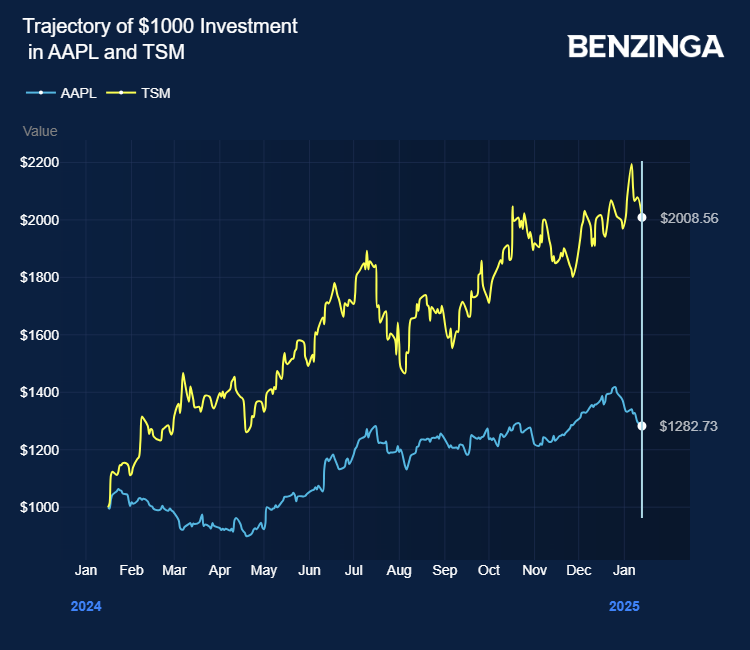
Taiwan Semiconductor stock surged over 98% in the last 12 months. Investors can gain exposure to the stocks of companies that manufacture semiconductors through VanEck Semiconductor ETF SMH and iShares Semiconductor ETF SOXX.

Price Action: TSM stock is down 0.65% at $200.05 at the last check on Tuesday.

Also Read:

Image via Shutterstock

Market News and Data brought to you by Benzinga APIs

5 Stocks Our Experts Predict Could Double In the Next Year

By submitting your email, you'll also get a free pivot & flow membership. A free daily market overview. You can unsubscribe at any time.