
Key Points
Warren Buffett retired as Berkshire Hathaway CEO on Dec. 31, 2025, handing the reins over to value-focused investor Greg Abel.
Despite Amazon’s competitive advantages and its artificial intelligence (AI)-driven growth at AWS, valuation concerns and the company’s lofty AI spending forecast may have spooked Berkshire’s now-former boss.
Before riding off into the proverbial sunset, Buffett scooped up over $4 billion worth of a company that dominates global internet search traffic.
- 10 stocks we like better than Alphabet ›
This isn’t your parents’ Berkshire Hathaway (NYSE: BRKA)(NYSE: BRKB) anymore. On Dec. 31, longtime billionaire boss Warren Buffett officially retired as CEO and passed the baton to Greg Abel, who’s been with Berkshire for more than a quarter century.
Under the Oracle of Omaha’s watch, Berkshire Hathaway transformed into a trillion-dollar business, with the company’s Class A shares (BRKA) rallying almost 6,100,000%! Buffett spearheaded the acquisition of roughly five dozen companies and oversaw a greater-than $300 billion investment portfolio.
Will AI create the world’s first trillionaire? Our team just released a report on the one little-known company, called an “Indispensable Monopoly” providing the critical technology Nvidia and Intel both need. Continue »
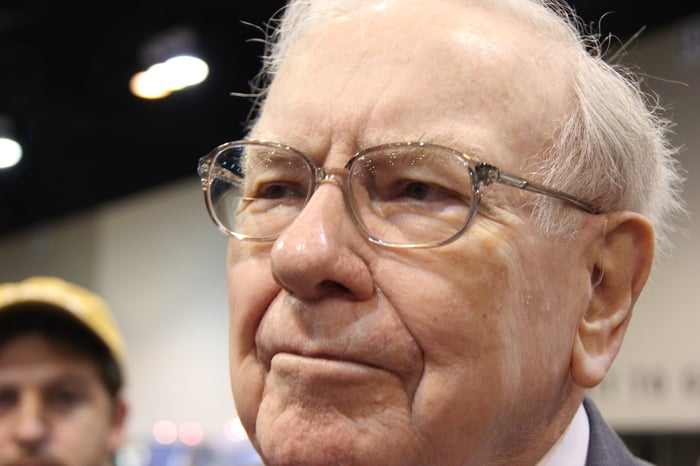
Warren Buffett retired as Berkshire’s CEO on Dec. 31, 2025. Image source: The Motley Fool.
Although Berkshire’s day-to-day operations and 48-stock portfolio are now under Abel’s watch, Buffett never stopped positioning the company that he and his late right-hand man, Charlie Munger, helped build for success. In the quarters leading up to his retirement, Warren Buffett went out with a bang.
According to quarterly filed Form 13Fs, Berkshire’s now-retired boss made waves by dumping 77% of his company’s stake in dual-industry leader Amazon (NASDAQ: AMZN), and sent ripples through Wall Street by piling into a virtual monopoly that’s been one of the stock market’s top performers over the last two decades.
The Oracle of Omaha slashed Berkshire’s Amazon stake by more than three-quarters
Though Warren Buffett was a persistent seller of Apple and Bank of America leading up to his retirement, it’s his actions with Amazon during the fourth quarter that truly raised investors’ eyebrows.
Berkshire Hathaway’s latest 13F shows that 7,724,000 shares of Amazon were sent to the chopping block, reducing this position by approximately 77%, or close to $1.7 billion in market value.
Most consumers and investors become familiar with Amazon through its world-leading online marketplace. But Amazon is a dual-industry leader, with Amazon Web Services (AWS) commanding close to a third of global cloud infrastructure services market share, based on total spend. Integrating generative artificial intelligence (AI) solutions and large language model capabilities into AWS has reaccelerated sales growth for this high-margin platform.
The million-dollar question is: Why would Buffett sell most of Berkshire’s stake in such an influential and dominant company?
One possible reason is Amazon’s valuation. Warren Buffett and Greg Abel are both unwavering value investors, and Amazon isn’t particularly cheap by traditional fundamental metrics, such as the price-to-earnings (P/E) ratio.
Additionally, the stock market entered 2026 at its second-priciest valuation since January 1871, according to the S&P 500‘s Shiller P/E Ratio. For 13 consecutive quarters leading up to the Oracle of Omaha’s retirement, he was a net seller of stocks to the tune of $187 billion. When equities are pricey, Buffett looks for stocks to unload.
Buffett and Abel might also have been leery about Amazon’s plans to aggressively spend on AI data centers. While AI is clearly accelerating growth at its cash cow, AWS, higher spending threatens to constrain near-term profits.

Image source: Getty Images.
Warren Buffett spent over $4 billion scooping up shares of this virtual monopoly
Even though net selling was the common theme in the lead-up to Buffett stepping down as CEO at the end of last year, he found a handful of bargains that whetted his whistle. Arguably, his most impactful purchase before riding off into the sunset was Google parent Alphabet (NASDAQ: GOOGL)(NASDAQ: GOOG) — a stock that’s soared by 13,600%, including dividends, since its initial public offering (IPO).
During the third quarter of 2025, Buffett oversaw the purchase of 17,846,142 Alphabet Class A shares (GOOGL), valued at more than $4.3 billion as of Sept. 30.
Warren Buffett is a big fan of businesses with sustainable competitive advantages. But legal monopolies really get the Oracle of Omaha’s attention. Alphabet’s internet search engine, Google, is effectively a virtual monopoly. Data from GlobalStats show that Google has maintained an 89% to 93% share of global internet search over the trailing decade. This lends Google exceptional ad pricing power and makes it the logical go-to for companies wanting to target users with their messages.
Berkshire’s now-retired billionaire boss is also keenly aware of the disproportionate nature of economic cycles. Although advertising is highly cyclical, periods of economic expansion last substantially longer than recessions. This simple numbers game heavily favors Alphabet’s ad-driven operating segments, which include streaming platform YouTube, over the long term.
Similar to Amazon, Alphabet’s cloud infrastructure service platform, Google Cloud, is thriving thanks to the incorporation of AI solutions. Google Cloud’s revenue growth reaccelerated to 48% in the fourth quarter.
While Alphabet is also planning to spend a small fortune on its artificial intelligence ambitions, Buffett may have felt more confident about it than Amazon for two reasons.
Firstly, Alphabet is sitting on a veritable treasure chest. It closed out 2025 with $126.8 billion in combined cash, cash equivalents, and marketable securities, and generated $164.7 billion in net cash from its operating activities. This is a fortress-type balance sheet and a market leader that has the ability to take risks.
The other selling point for Alphabet relative to Amazon has been its attractive valuation. Alphabet has historically traded at a lower P/E ratio than Amazon.
Despite Alphabet not being Warren Buffett’s final purchase in 2025, it may end up as his most impactful.
Should you buy stock in Alphabet right now?
Before you buy stock in Alphabet, consider this:
The Motley Fool Stock Advisor analyst team just identified what they believe are the 10 best stocks for investors to buy now… and Alphabet wasn’t one of them. The 10 stocks that made the cut could produce monster returns in the coming years.
Consider when Netflix made this list on December 17, 2004… if you invested $1,000 at the time of our recommendation, you’d have $496,797!* Or when Nvidia made this list on April 15, 2005… if you invested $1,000 at the time of our recommendation, you’d have $1,282,815!*
Now, it’s worth noting Stock Advisor’s total average return is 979% — a market-crushing outperformance compared to 200% for the S&P 500. Don’t miss the latest top 10 list, available with Stock Advisor, and join an investing community built by individual investors for individual investors.
*Stock Advisor returns as of May 1, 2026.
Bank of America is an advertising partner of Motley Fool Money. Sean Williams has positions in Alphabet, Amazon, and Bank of America. The Motley Fool has positions in and recommends Alphabet, Amazon, Apple, and Berkshire Hathaway. The Motley Fool has a disclosure policy.
5 Stocks Our Experts Predict Could Double In the Next Year
By submitting your email, you'll also get a free pivot & flow membership. A free daily market overview. You can unsubscribe at any time.