
Key Points
Soaring demand for Nvidia’s GPUs has made it the world’s largest company by market cap.
CEO Jensen Huang forecast that the market for AI infrastructure would be worth $3 trillion to $4 trillion by 2030.
Nvidia’s ability to keep growing rapidly even at its now-massive scale indicates that Huang could be right.
- 10 stocks we like better than Nvidia ›
It was a year ago that Nvidia (NASDAQ: NVDA) CEO Jensen Huang shocked the markets with a bold prediction. In a call with analysts following the company’s fiscal second-quarter 2026 earnings results, Huang predicted that artificial intelligence infrastructure spending would reach $3 trillion to $4 trillion by the end of the decade. It was an ambitious prediction, particularly considering that research firms such as Grand View Research believe the entire AI market — not just infrastructure — would be valued at $3.5 trillion by 2033. Huang’s forecast is only for infrastructure — it doesn’t include software or enterprise applications.
“The last couple of years, you have seen that capex has grown in just the top four CSPs [cloud service providers] by — has doubled and grown to about $600 billion,” Huang told analysts at the time. “So we’re in the beginning of this build-out, and the AI technology advances has really enabled AI to be able to adopt and solve problems to many different industries.”
Missed AI’s “Act 1”? Act 2 Could Be 15x Bigger. Most investors think they missed the AI boat because they didn’t buy Nvidia in 2005. But according to our analysts, we’re only at the end of “Act 1″—the R&D phase. “Act 2” is the global rollout. Continue »
A lot has changed since then. Cloud companies continue to build data centers, but there are definite headwinds in the AI space. Shortages of processors, memory chips, and data storage devices threaten to limit the pace of the build-out and AI revenue growth. Foundries are operating at full capacity. And leaders of top AI firms are publicly pushing for a slowdown in frontier model development, citing risks that AI technology lacks enough guardrails.
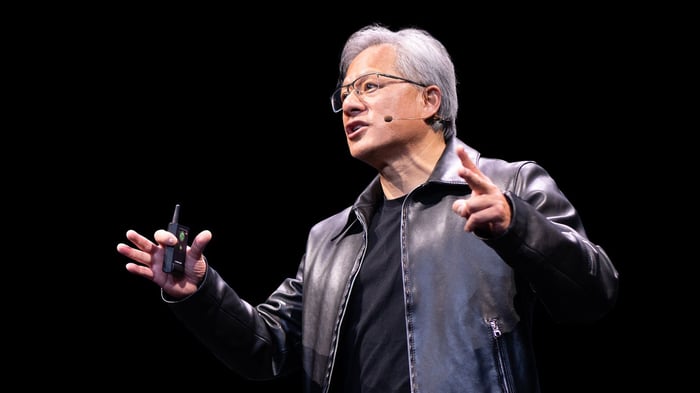
Nvidia CEO Jensen Huang. Image source: Nvidia.
But Huang is undeterred. And speaking at the Goldman Sachs Communicopia & Tech conference last week, he doubled down on his year-ago prediction that AI infrastructure would be worth $3 trillion to $4 trillion in 2030.
“The semiconductor industry is going to just keep getting larger and larger, which is what we’re seeing now [with] these two fundamental ideas, that we have a new layer of computing with a new application and the end of Moore’s law,” Huang said. “Meanwhile, people are expecting these AI models to be smarter and smarter because they don’t like wrong answers. Then the compounded result of that should result in a very large industry.”
Nvidia’s numbers speak volumes
If anything, Nvidia’s most recent earnings report backs Huang’s position that the AI build-out has plenty of room to run. Revenue in its fiscal 2027 second quarter (which ended July 26) was up a whopping 106% year over year to $96.2 billion. Of that total, $89 billion was data center revenue, which was up 117%.
Nvidia’s gross margin — a ridiculously healthy 72.4% a year ago — improved to 75%, and net income surged by 126% to $59.68 billion. Nvidia reported diluted earnings per share of $2.46, versus $1.08 in the year-ago period.
Nvidia’s strength lies in its powerful processors that provide the backbone for training and running complex AI workloads. Nvidia’s graphics processing units (GPUs) are deployed by the thousands in data centers, and the company sells them faster than it can make them. Its most recent generation, the Vera Rubin architecture, uses NVLink chip-to-chip interconnects so its Rubin GPUs and Vera central processing units (CPUs) can share memory and improve efficiency. Nvidia said Vera Rubin is in full production, and its racks are being installed in data centers operated by CoreWeave, Alphabet, Microsoft, Oracle, and Nebius Group.
“Having already received purchase orders from every major hyperscaler, AI cloud, and system OEM, we expect Vera Rubin to mark the fastest product ramp in Nvidia’s history,” CFO Colette Kress said.
What to expect from Nvidia stock
Nvidia stock has been a solid performer this year, up nearly 14%, somewhat outpacing the S&P 500’s 10% gain. And based on analysts’ consensus price target of $328 on the stock, investors can reasonably expect 54% upside over the next 12 months.
Huang has been right more often than he has been wrong as Nvidia skyrocketed to a $5 trillion market cap and took the title of largest company in the world. Even if the AI infrastructure market’s growth falls short of his 2030 prediction, I think Nvidia still has a lot of runway to reward investors.
Should you buy stock in Nvidia right now?
Before you buy stock in Nvidia, consider this:
The Motley Fool Stock Advisor analyst team just identified what they believe are the 10 best stocks for investors to buy now… and Nvidia wasn’t one of them. The 10 stocks that made the cut could produce monster returns in the coming years.
Consider when Netflix made this list on December 17, 2004… if you invested $1,000 at the time of our recommendation, you’d have $412,074!* Or when Nvidia made this list on April 15, 2005… if you invested $1,000 at the time of our recommendation, you’d have $1,314,319!*
Now, it’s worth noting Stock Advisor’s total average return is 932% — a market-crushing outperformance compared to 209% for the S&P 500. Don’t miss the latest top 10 list, available with Stock Advisor, and join an investing community built by individual investors for individual investors.
*Stock Advisor returns as of September 17, 2026.
Patrick Sanders has positions in Nebius Group and Nvidia. The Motley Fool has positions in and recommends Alphabet, Goldman Sachs Group, Microsoft, Nvidia, and Oracle. The Motley Fool has a disclosure policy.
5 Stocks Our Experts Predict Could Double In the Next Year
By submitting your email, you'll also get a free pivot & flow membership. A free daily market overview. You can unsubscribe at any time.